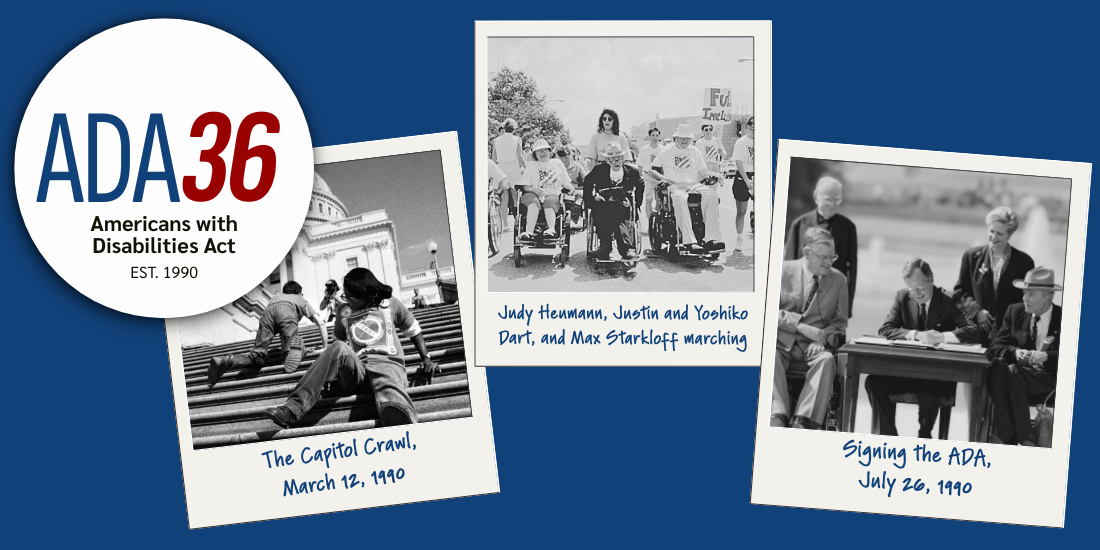
ADA 36: Americans with Disabilities Act established 1990. Photos: The Capitol Crawl, March 12, 1990. Judy Heumann, Justin and Yoshiko Dart, and Max Starkloff leading a march. President George H.W. Bush with disabled advocates at his side signing he ADA on July 26, 1990.

Promise, Pride, and Possibility: 36 Years of the ADA

Author:

Starkloff Staff

Reading time:

6 minutes

Date:

July 27, 2026

Share This:

“Without it, there would be no life.”

This month marks 36 years since President George H.W. Bush signed the Americans with Disabilities Act into law. From the South Lawn of the White House he called it a sledgehammer to a wall that had for too many generations separated Americans with disabilities from the freedom they could glimpse but not grasp. For the disabled community, that day launched a new independence day.

What Disability Pride and the ADA mean to us

Being a disability-led organization is core to our mission. As people with disabilities, we are the experts on what we need. We know how much access and inclusion matter because it is essential to our own lives.

To celebrate Disability Pride Month, the SDI team shares what disability pride and the ADA anniversary mean to them personally. Each answer is a reminder of how much changed that day, and how much work still remains.

Before and after the ADA

As a blind person with additional invisible disabilities, it’s hard to imagine (remember) my life without the ADA. The ADA was passed when I was in 5th grade and I remember my elementary school not having to teach me braille and our neighborhood public school being able to say I couldn’t go there. My family had to move to find a school that would accept me.

As an adult, the ADA lets me travel with my Seeing Eye dog anywhere the public can go. Without the ADA, I would have to ask permission to bring my mobility aid almost everywhere and businesses could legally say no. I’d have to essentially beg to be able to grocery shop, go to medical appointments, attend a theatrical performance, or ride the Metrolink to work. My employer would not be obligated to provide me with accessible technology or materials.

The ADA touches every aspect of my life. Without it, there would be no life.

–Natasha

Associate Director of Career Services

The ADA becoming law is like Dorothy waking up in the Land of Oz—the world became technicolor. It wasn’t immediate, but the difference is everywhere, adding vitality and depth. It’s hard to comprehend how much we were missing in black and white. Our legal framework was finally catching up to human experience. How could we go back?

Disability has always been part of being human. Institutions and ugly laws can’t change that—they just strip people of rights and dignity, and everyone suffers the loss. My disabilities aren’t apparent to most people, but without the ADA, I’d have to hide so much of myself just to be part of the world. The stigma of exclusion would prevent easy access life-saving treatment. I’m part of the ADA generation, and I won’t go back to a world that forces us to disappear.

–Maggie

Director of Communications

Pride is something you build

The ADA opened doors. Disability pride is the confidence to walk through them without apology. It is something people build for themselves, often slowly.

Autism, my invisible disability, was not diagnosed until I was 21. I have a childhood worth of memories of authority figures in my life saying I was rude, poorly behaved, or unable to function at the same level as others based on personal failings.

I thought there was something wrong with me and I was so mad at myself for not being like everyone else and succeeding out of high school. For me, I cultivated disability pride by reflecting on my childhood and forgiving myself. I started reframing my experiences as those of someone in a world that was not designed to help them succeed. Now, I see my childhood as a story of perseverance rather than failure.

–Joseph

Dream Big Camp Lead Teacher

What has helped me the most is educating myself on my own disabilities and connecting with others in my community. Whether it’s attending webinars and reading books about how to manage my brain, or connecting with coworkers and friends with disabilities of their own, hearing those shared experiences and witnessing other folks with disabilities succeed and thrive gave me a new appreciation for myself and made it feel possible to truly enjoy the day rather than just get through it.

Having pride in yourself is something you are constantly working toward, and you are not always going to feel it, and that’s okay! During these times, it’s important to look at what you have done, or what you are grateful for. Before bed (especially on hard days), I recommend listing 3 things you did that day or are grateful for. Even if it seems silly or insignificant, it is still proof that you are here.

–Jenna

Career Services Coordinator

In junior high and high school, I avoided other people with disabilities because I didn’t want to be associated with “those” people. I thought having friends without disabilities would somehow make me cooler.

When I left for college at Mizzou, it was different. I didn’t feel the same pressure to fit in. With so many different people and perspectives, there was room to be different. Over time, I met many people with disabilities, including my first mentor. I quickly realized I had a deep connection with others who shared my lived experience.

Disability became a source of pride and something worth fighting for. That was when I began to move from feeling ashamed of my disability to becoming an advocate.

–Aimee

Chief Development Officer

Investing in access benefits everyone

The ADA was never only for one group. Our communities are stronger when disabled and nondisabled people all have a seat at the table. Access, done right, expands what’s possible for all of us.

The ADA means living and existing in a community where all can be included.

The ADA creates greater ease for everyone (hello curb cuts!) and helps us imagine a world that is more accepting and welcoming for all.

–Alli

Annual Fund Manager

The ADA means making intentional efforts to include everyone in public life: meaningful work, public infrastructure, entertainment, and civic engagement.

–Todd

Grant Writer

Our role in this legacy

Disability pride and the equal opportunity promised by the ADA shapes everything we do here at Starkloff. Our founders, Max and Colleen Starkloff, dedicated their lives advancing disability rights. United with disabled people across the country, they fought for inclusion, inch by inch, over decades. Their advocacy delivered the Americans with Disabilities Act, the world’s first comprehensive declaration of equality for people with disabilities.

We are proud to be disability-led, and to keep building on the work they started: helping disabled candidates step confidently into competitive careers, and helping employers and communities recognize disability as the normal, valuable part of human life it has always been.

The work still ahead

The ADA gave us a floor, not a finish line. The unemployment rate for disabled college graduates remains more than double that of their nondisabled peers, and disabled people are more than twice as likely to live in poverty. Barriers, not limitations, keep that gap open, and barriers can be dismantled.

Thirty-six years in, we’re still building the technicolor world the ADA promised. Your support is part of how that happens. Thank you for standing with us as we keep pushing, one door, one workplace, one welcome at a time.

Together we can achieve our vision: disabled people thriving.
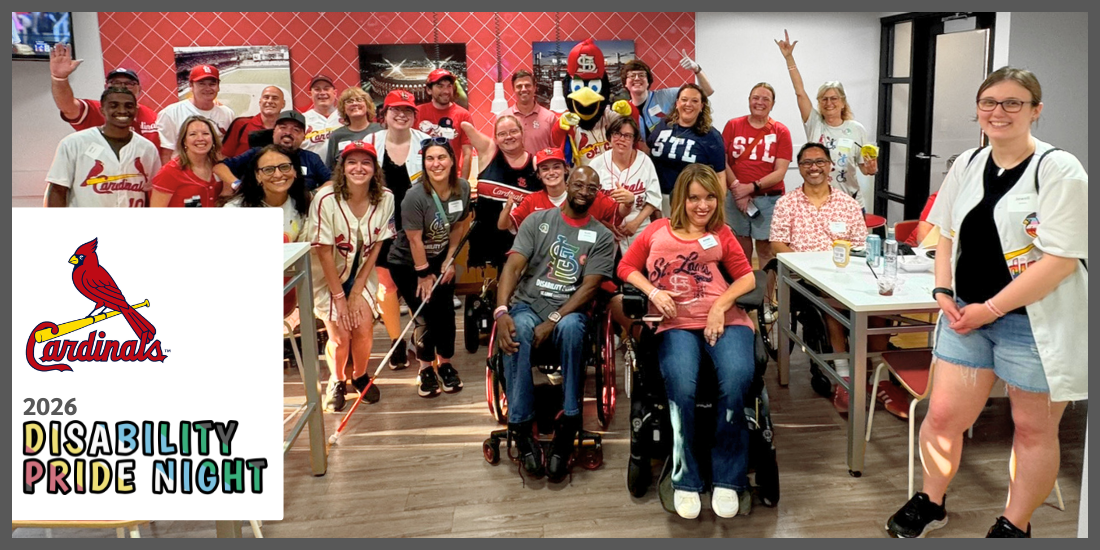
Cardinals 2026 Disability Pride Night. About 25 adults in Cardinals Disability Pride shirts in a suite with Fredbird at Busch Stadium, all beaming at the camera. The group includes disabled and nondisabled people, apparent disabilities include manual and power wheelchair users, a person with limb difference, and a person holding a white cane. Everyone is having a great time!

Get the latest news & updates

Subscribe to SDI's Newsletter

* indicates required

Check Out Our Recent Posts: