
What Gets Measured Gets Done: Why We’re Speaking Up This Labor Day
Author:
Starkloff Staff
Reading time:
6 minutes
Date:
September 4, 2026
This Labor Day, as the country pauses to celebrate the dignity and contribution of work, we want to talk about a piece of federal policy that some people will never hear about, but that has shaped disability employment in this country for more than a decade.
The U.S. Department of Labor’s Office of Federal Contract Compliance Programs (OFCCP) finalized rules that eliminate two of the most important tools federal contractors have used since 2013 to track and improve how they hire, retain, and promote people with disabilities: voluntary disability self-identification and the 7% utilization goal. Most of these changes take effect on September 21, 2026.
We think this is the wrong direction, and we want our community (and everyone who believes disabled people deserve full economic participation) to understand what’s changing and why it matters.
What’s Actually Changing
Since 2013, federal contractors (companies that do business with the federal government) have been required to do two things under Section 503 of the Rehabilitation Act:
- Invite applicants and employees to voluntarily self-identify as individuals with disabilities, using a simple, confidential form (Form CC-305).
- Measure their workforce against a 7% utilization goal, a benchmark for how many qualified people with disabilities should be represented in their workforce, or within each job group.
The new OFCCP rule eliminates both requirements. Contractors are still required to take affirmative action to employ and advance people with disabilities under Section 503—but without the data collection and the benchmark, there’s no longer a clear, consistent way to measure whether that’s actually happening.
Contractors are still required to take affirmative action to employ with disabilities—but without the data collection and the benchmark, there’s no longer a clear, consistent way to measure whether that’s actually happening.
Not a New Fight
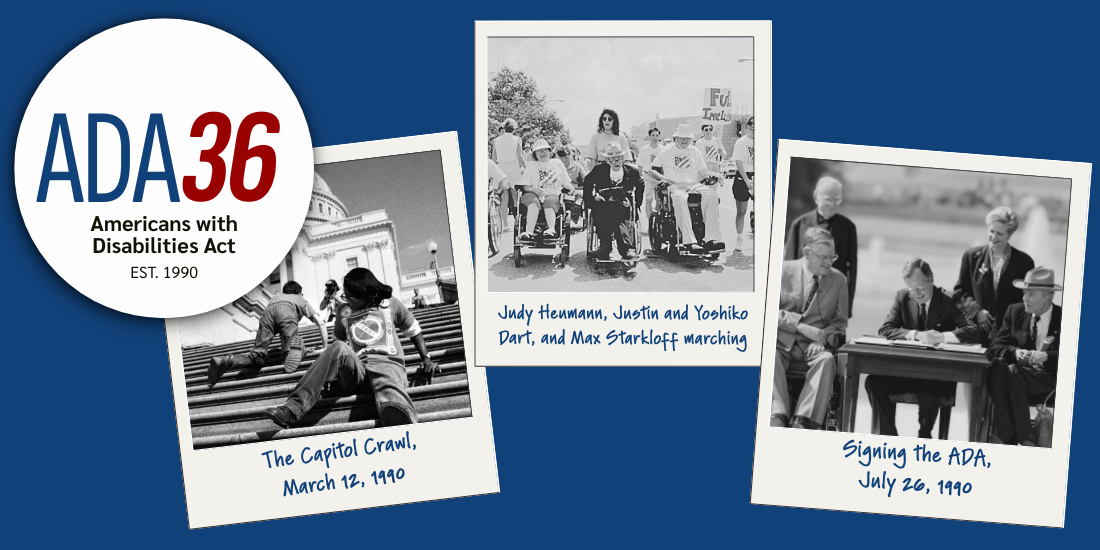
This isn’t the first time we’ve watched policy protections for disabled workers come under pressure, and it won’t be the last. Our founder, Max Starkloff, spent his life fighting for the basic premise that disabled people belong in the workforce, in their communities, and in the rooms where decisions about their lives are made.
That fight didn’t end with the passage of the ADA in 1990, and it didn’t end with the creation of the 7% utilization goal in 2013. Every generation of disability advocates has had to defend, re-defend, and rebuild the tools that make real inclusion possible.
The self-ID requirement and the 7% goal were themselves the result of a multi-year rulemaking process, built on decades of data showing that “good faith effort” alone wasn’t closing the employment gap for disabled workers. As OFCCP itself put it when the rule was finalized in 2013, the whole premise was that what gets measured gets done.
We believe that’s still true today. And we believe walking away from the measurement walks away from the progress.
The Gaps Remain Wide
One in four working-age Americans has a disability covered under the Americans with Disabilities Act, a substantial share of the country’s workforce. The numbers are stark:
- Working-age people with disabilities participate in the labor force at roughly 41%, compared to about 75% for people without disabilities.
- Disabled workers are twice as likely to be unemployed as their nondisabled peers.
- More than 24% of people with disabilities aged 18–64 live in poverty, compared to under 10% of nondisabled people in the same age range.
These aren’t abstractions. They represent neighbors, coworkers, family members, and the disabled professionals and job seekers we work with every day. When we talk to job seekers navigating this landscape, these numbers show up as real barriers: fewer interviews, longer job searches, and employers who don’t know how—or don’t feel obligated—to build genuinely accessible hiring pipelines.
As OFCCP itself put it when the rule was finalized in 2013, the whole premise was that what gets measured gets done.
The Old Framework Was Working
Here’s what makes this change particularly hard to accept: the data shows the previous framework was succeeding.
Research on federal contractors under the existing Section 503 rules found that they have consistently outperformed non-contractor employers on disability employment:
- Federal contractors hire roughly twice as many people with disabilities each year as non-contractors.
- They promote 87% more employees with disabilities.
- Overall, they employ 21% more people with disabilities than non-contractor peers.
This isn’t a coincidence. When employers are required to collect the data and measure themselves against a goal, they build the infrastructure—recruitment partnerships, accommodation processes, accountability structures—that make inclusive hiring durable rather than incidental. Take away the measurement, and there’s a real risk that this infrastructure quietly erodes, even if no employer explicitly decides to hire fewer disabled workers.
Why This Matters to Our Mission
Economic mobility for people with disabilities is not something that happens through good intentions alone. It happens through deliberate, measurable action in recruitment, in hiring, in retention, and in promotion. That’s the whole premise of the work we do at Starkloff Disability Institute, every day, with every employer we consult with and every disabled professional we support.
We know from firsthand experience that when employers have a clear benchmark and real data about their own workforce, they make different and better decisions. They rethink job postings that unintentionally screen out qualified disabled candidates. They invest in accessible interview processes. They build promotion pathways instead of hiring disabled employees into roles with no room to grow. And they make sure every employee’s accommodation needs are being met on an ongoing basis, not just addressed once during onboarding and then forgotten. Strip away the requirement to measure any of that, and it becomes far easier for inclusion work to slide down the list of priorities.
We firmly oppose this rollback. Not because compliance paperwork is sacred, but because the data behind it was never just paperwork. It was the mechanism that made accountability possible.
What You Can Do
Talk to your own organization’s HR and compliance teams. If you work for or with a federal contractor, ask whether they plan to continue voluntary self-ID and internal benchmarking even without a federal requirement to do so. Voluntary, well-designed self-ID programs are still entirely legal—and still incredibly important.
Join us at the Starkloff Disability Employment Summit, October 7-8. This is exactly the conversation we’ll be having with employers, HR leaders, and disability advocates from across the region about what it actually takes to build a disability-inclusive workforce from recruitment through retention and advancement, regardless of what federal law requires. Learn more and register
Share this with your network. Most people have never heard of Section 503, the 7% utilization goal, or Form CC-305. Policy changes like this move quietly, and public attention is one of the few things that consistently shapes how they play out. If this matters to you, help us make sure more people know it’s happening.
Support SDI’s ongoing work. As federal requirements shrink, the work of building disability-inclusive workplaces doesn’t go away; it just becomes work that has to be chosen rather than mandated. That’s the work we’re here to do, with or without a federal mandate behind it. Consider a gift to support our disability-led programs that empower and educate.