
Disability Pride Month 2026: What Thirty Years Taught Me About Pride
Author:
Steven Foelsch, M. Ed.
Reading time:
6 minutes
Date:
July 28, 2026
The day I graduated from high school was the happiest day of my first eighteen years. I had no grand plan for my future beyond working construction, playing in a band, and riding my motorcycle. Life felt wide open, and I believed I had all the time in the world.
The day everything changed
Just over two years later came the most terrifying day of my life.
I woke up in a hospital and was told I had sustained a spinal cord injury. Doctors explained that I would most likely never walk or use my arms again. In a matter of minutes, the future I had imagined disappeared.
More than forty years later, I have had the privilege of reflecting on that journey. Ironically, it is only in recent years that I have truly come to understand what Disability Pride means.

Steve Foelsch
Learning what “proud” really means
When I first began living independently while attending college, I wasn’t so much ashamed of my disability as I was uncomfortable with it. Whenever I heard the phrase Disability Pride, I would quietly ask myself, “Proud of what?”
My world revolved around learning how to live with my own disability. I knew almost nothing about disability history or the advocates who came before me. I didn’t know how many generations fought so people like me could go to college, live in the community, ride accessible transportation, and pursue careers alongside everyone else.
I took all of those opportunities for granted because I assumed they had always existed.
Quite honestly, I wanted as little to do with disability as possible. I refused to join advocacy organizations or seek out disability resources. I didn’t advocate for accommodations, even when I needed them. I accepted barriers that should have been challenged. Most importantly, I isolated myself from other people with disabilities.
Looking back, that was one of the biggest mistakes of my life. My life would have been easier, safer, and more fulfilling had I listened to the wisdom and experiences of those who had already traveled the road before me.
The book that changed my life
Everything began to change after graduate school, when I returned to St. Louis and met Colleen Starkloff. After hearing my story, she invited me to help develop a Disability Studies program at Maryville University. I never called her back.
Here I was—a recent graduate with a master’s degree in education, living in public housing, offered a chance to help shape disability education—and I simply ignored it. Looking back, I think Colleen understood something that I didn’t yet understand about myself: I still wanted nothing to do with disability.
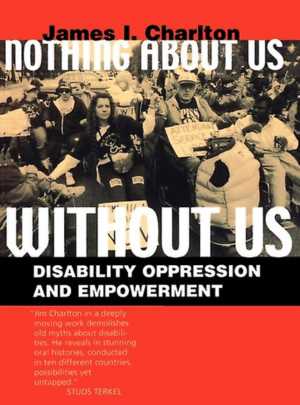
About a week later, she showed up at my apartment carrying a book. It was Nothing About Us Without Us by James Charlton.
That book changed my life.
For the first time, disability was presented not as a medical condition to be treated or pitied, but as a civil rights movement. Charlton described disability through the lenses of politics, history, economics, and human rights. Suddenly, my own life made sense.
I realized that disability rights are civil rights. The curb cuts I rolled across every day, accessible buses, the Americans with Disabilities Act, independent living centers, personal assistance services, and opportunities for education and employment were not acts of charity. They were the result of decades of organizing, protesting, lobbying, litigation, and persistence by disabled people and their allies who refused to accept segregation and exclusion.
I also realized something equally important: those victories were not permanent. Every generation inherits the responsibility to protect the rights won by the generation before it.
Why Disability Pride Month in 2026 matters more than ever
That lesson feels especially relevant today. As we celebrate Disability Pride Month in 2026, we also find ourselves confronting renewed challenges to one of the disability rights movement’s greatest achievements: the right to live in our communities. Recent actions by the U.S. Department of Justice have questioned decades of federal enforcement of the Olmstead decision. This landmark Supreme Court case recognized that unnecessary institutionalization can be a form of discrimination under the Americans with Disabilities Act.
For many people without disabilities, this may sound like an abstract legal debate. For those of us who depend on home and community based services to live independently, work, raise families, and participate in our communities, it is deeply personal.
History reminds us that rights are rarely lost all at once. They are often weakened gradually, when people assume someone else will defend them.
One of the greatest privileges of my career was participating in the early years of Dream Big, Starkloff Disability Institute’s youth program. Watching young people with disabilities discover confidence, community, and leadership reminded me of lessons that had taken me nearly thirty years to learn myself. They embraced disability not as something to hide, but as part of who they are. They understood instinctively what I had spent decades discovering: Disability Pride is not about celebrating limitations. It is about recognizing our shared history, our culture, and our collective responsibility to build a more inclusive society.
Pride, knowledge, and action
Today, I can finally say that I understand Disability Pride.
I am proud of our community. I am proud of the generations who crawled up the steps of the U.S. Capitol, occupied federal buildings, challenged inaccessible systems, and demanded equal rights—not only for themselves, but for people like me and for generations they would never meet. I am proud of our resilience, our creativity, our advocacy, and our willingness to teach one another.
But pride alone is not enough.
One of my favorite quotes reminds us that “knowledge without action is impotence, and action without knowledge is insanity.”
I would add one more thought. Pride without effort and accomplishment becomes arrogance. Effort and accomplishment without pride becomes fleeting. But knowledge, action, and pride together become the foundation of lasting social change.
Disability Pride is not simply about celebrating who we are. It is about understanding where we came from, honoring those who fought before us, defending the rights we have today, and ensuring that future generations never have to fight the same battles all over again.
That is something truly worth being proud of.
Notes
Home and community based services, often abbreviated as HCBS, is a health and human services policy term for supports that let people live in their own homes instead of institutions or other isolated settings.
“Knowledge without action is impotence, and action without knowledge is insanity.” Various translations of this quote are attributed to multiple philosophers and scholars throughout history including: Abu Bakr (1st century), Al-Ghazali (11th century), Sai Baba of Shirdi (19th century), and Kwame Nkrumah (20th century).
Disability Pride Flag: The image at the top of this post is the digital version of the Disability Pride flag designed by Ann Macgill, a writer with cerebral palsy, and later updated based on community feedback. The diagonal band represents cutting across barriers. The black field/background represents mourning, rage, rebellion, protest. The lowered saturation is used for illuminated screens. The parallel lines represent solidarity, with each of the five colors representing a different type of disability.
- Red: physical disabilities
- Gold: neurodivergence
- White: invisible and undiagnosed disabilities
- Blue: psychiatric disabilities
- Green: sensory disabilities